
Weekly Dev Roundup: August 10–17
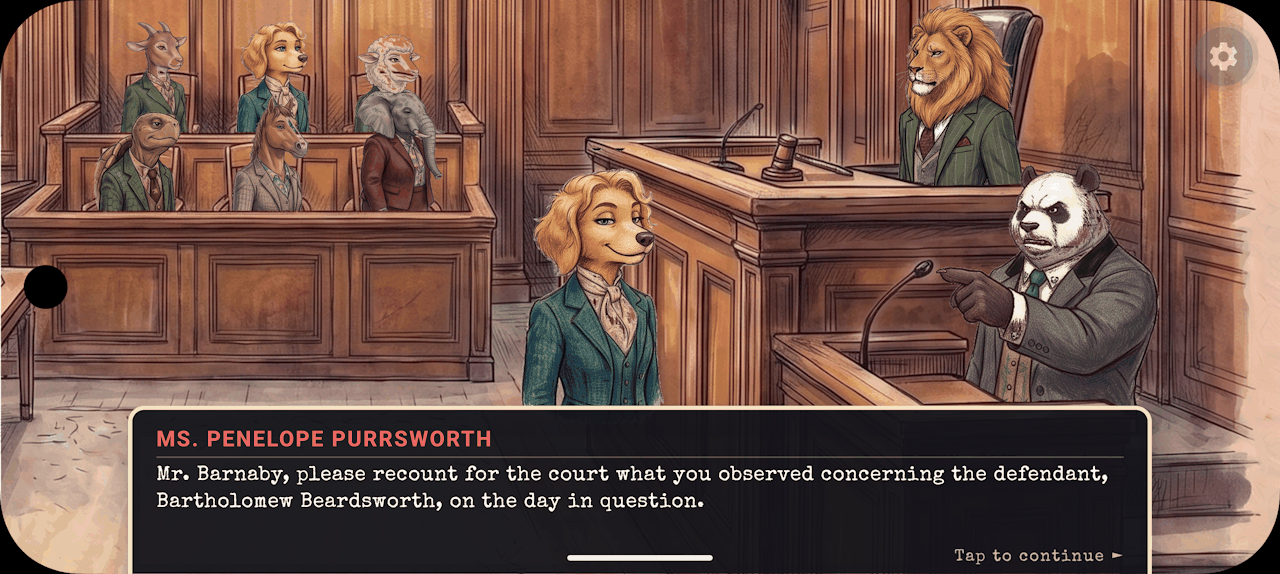
The quietest thing in game development is a repo with no commits, and this week four of our five repos were exactly that — silent, stable, doing their thing. The one exception was the newest game in the lineup, and it was anything but quiet. Special Bylaw Unit is barely two and a half weeks old, and this past week it went on the biggest feature tear I've seen since Doodle Doo's early days. One project, one week, and one complete courtroom loop built from opening statement to broken witness.
Special Bylaw Unit
Some projects start slow — a commit here, a commit there, feeling out what the thing even wants to be. Special Bylaw Unit is not one of those projects. It launched on the last day of July and has been sprinting ever since, but this week was different: this was the week it stopped being a pile of screens and became an actual game loop.
The premise is courtroom drama played straight — you're defending animal clients in a world of jury selection, witness testimony, and cross-examination. Which means the loop isn't one mechanic, it's a sequence of phases the player has to move through, and building a sequence like that means building each beat in order. That's exactly what happened, one commit at a time, all week.
The Prosecution Pipeline
The week opened with the trial itself: the Crown Prosecution Start. It's the moment the case gets laid out, the charges get read, and the first witness takes the stand. But it isn't just a splash screen — the system generates witnesses dynamically, each one with their own species, personality, and testimony to hand over. The moment that landed, the game had stakes. There's an actual case on the docket and an actual animal on the stand.
Right behind it came the juror reaction matrix, which is one of those features that sounds dry on paper and turns out to be the thing that makes the whole room feel alive. Every juror has a species-specific headshot and a set of emotional reactions, and they respond in real time — to testimony, to objections, to the way a line of questioning lands. The fox juror's ears perk when the crown scores a point; the sheep juror starts looking uncertain when the defense fumbles. It's a small thing in code and an enormous thing in feel. A courtroom full of animals reacting to the drama as it happens is the exact kind of detail that makes someone hand their phone to a friend and say look at this.
Cross-Examination
Midweek brought cross-examination, and this is where the game grew teeth. Cross-examining a witness isn't just tapping through dialogue options — there's a composure system under it. Witnesses have a composure stat that tracks how well they're holding up under pressure, and the trial UI shifted to a horizontal card layout built specifically for the push-and-pull rhythm of pressing someone on the stand.
The dialogue flows got the full treatment too — parallel fallback branches, so if a witness deflects one angle there's always another to try, plus objection mechanics so the defense can push back against an aggressive line of questioning and the system has to answer for it. None of this is about making the player feel like they're clicking through a visual novel; it's about making them feel like they're in a duel, and the other side is allowed to fight back.
The Witness Break
And then, near the end of the week, one of those perfectly-named commits that tells you the whole story in a single line: add witness break mechanic during cross-examination with graphic breakdown overlay.
A witness break is exactly what it sounds like. Press hard enough, and the witness cracks — and the game shows it, with a graphic breakdown overlay that marks the moment of collapse. That's the payoff the entire week was building toward. You open the prosecution, you question the witness, you track their composure, you dance around objections — and then, if you've done it right, you break them. It's the single most satisfying beat in the courtroom genre, and Special Bylaw Unit has it now.
What struck me most about this week wasn't the volume; it was the method. Every commit built directly on the one before it — witness generation, then juror reactions, then cross-examination, then composure, then the breakdown. I wasn't just throwing features at a wall and hoping something stuck; I was building a scene, beat by beat, and at every step I knew exactly where I was headed next.
The Rest of the Lineup
The other games had a quiet week — no commits pushed to any of them. And honestly, I'm glad. They're in a stable place right now, and when one project is having the kind of breakthrough week Special Bylaw Unit just had, it's probably for the best that the others stayed out of the way and let the spotlight land where it belonged.
Quiet weeks aren't dead weeks. They're just the natural rhythm of a studio that isn't trying to set itself on fire every seven days. One fire burning bright is more than enough to keep the kitchen warm.
I'll be back next week with whatever the git history decides to cough up. If Special Bylaw Unit keeps this pace, we might be looking at a playable trial loop a whole lot sooner than anyone expected.