
Weekly Dev Roundup: Oct 19–26
Some weeks one game demands all the oxygen, and this was one of them. Special Bylaw Unit had a monster week — the kind where you look back at the commit log and realize you basically rebuilt the game's relationship with reality. Headline Harmonies, Doodle Doo, Infinite Scribe, and ShutterClash all sat quiet. No complaints from me — SBU needed every minute.
Special Bylaw Unit
One of the things that's fascinating about building a game that runs on AI is that you spend the first phase just trying to get it to work, and then one day you look up and realize you're not debugging prompts anymore — you're hardening a product. That transition happened this week, and it happened hard.
The front half of the week was a production preparation blitz. Over two days, the repo absorbed security hardening across every layer: proper JWT secret handling, removing every trace of mock authentication, sanitizing error responses so nothing leaks, adding idempotency middleware so a shaky mobile connection doesn't corrupt game state, and locking down CORS origins. The Docker build went multi-stage with the container running as non-root. Cloud Run startup races got eliminated. The database stopped silently falling back to SQLite in production — a bug that's been lurking since the early days and could've been catastrophic if it'd triggered at the wrong moment.
At the same time, performance got a thorough going-over. The courtroom's 1,250 character headshots — every juror, every witness expression — now lazy-load instead of jamming themselves into memory all at once. Backdrops converted to optimized WebP textures. The typewriter text effect got isolated into its own memoized component so it stops thrashing the dialogue. Lists in the transcript modal and active files view got virtualized. These aren't glamorous changes, but they're the difference between a game that feels smooth and one that chugs at the wrong moment.
Then came the moment that made it real: Apple Sign-In went from mocked to authentic. No more fake credentials, no more "we'll hook this up later." Real Sign In with Apple, plus an in-app account deletion flow and a proper logout UI. One commit for each, and suddenly the game wasn't a prototype anymore — it was something a real person could sign into with their real Apple ID, and also leave if they wanted to. That second part matters; giving people a clean exit builds trust in a way that smooth onboarding alone never can.
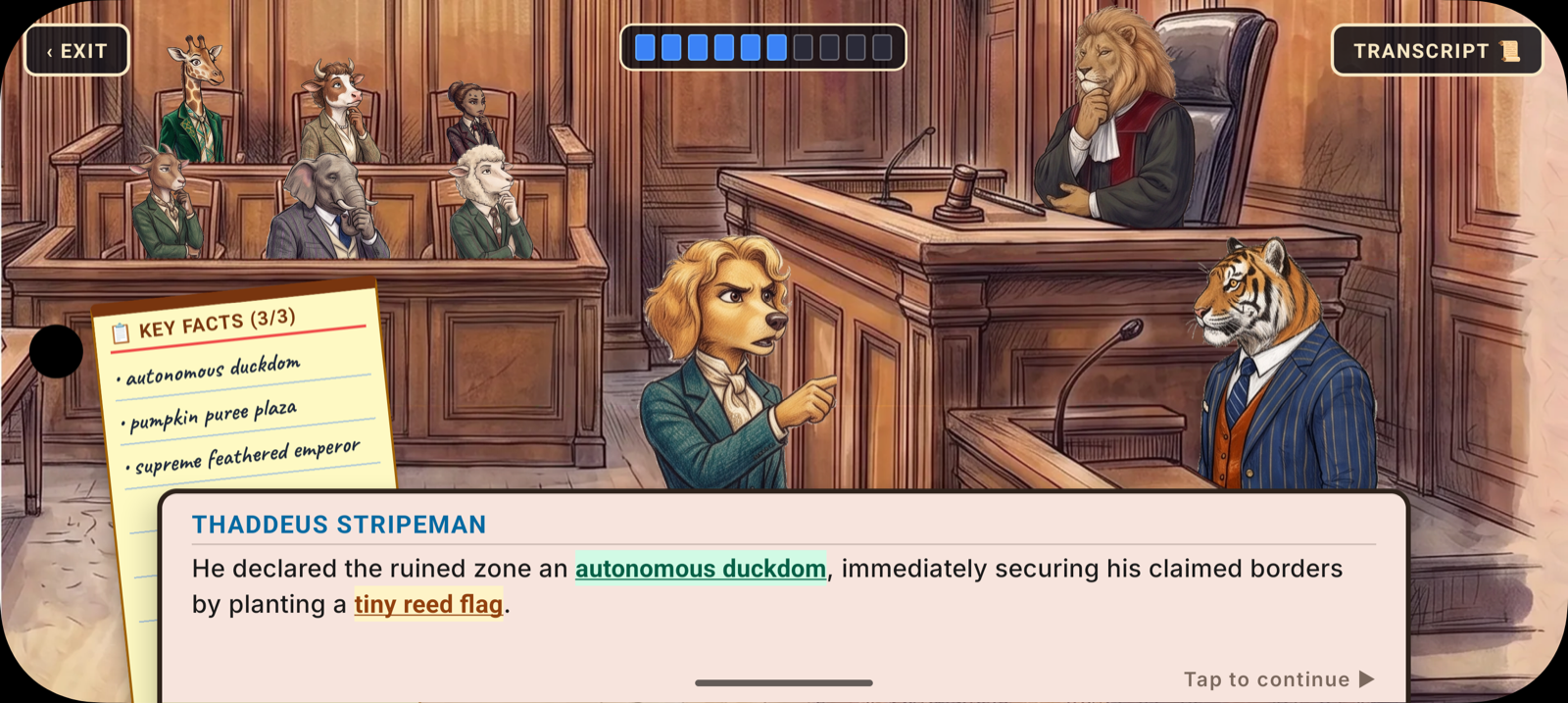
Midweek, the courtroom got a personality injection. Judge Rory's name got standardized across every screen — he'd been "the judge" in some places and "Judge Rory" in others, and that inconsistency was quietly undermining the sense that you're in a room with actual characters. The objection flow got lawyer dialogue and headshot switching, so when Molly Pawsworth objects during cross-examination, you see her face and the judge's ruling lands with a visual punch. Custom court-styled error dialogs replaced the generic system alerts — instead of a phone-style popup, you get something that looks like it belongs in a courtroom. The typewriter pace locked in at 28ms across every screen. These are tiny details individually, but together they're the difference between "a game about a courtroom" and "being in the courtroom."
The cross-examination system got some real teeth. Direct examination question options now shuffle, so the experience doesn't feel scripted on replay. Witness breakdown confessions — those moments on cross-exam where a witness cracks — now relate directly to the question you asked, with a 35-word limit that keeps them punchy. Breakdowns are restricted to the third turn, which means you have to earn them; you can't just hammer a witness from the opening bell.
The tutorial landed too — a case overlay that walks new players through their first trial, plus tracking so the game knows who's been through it. This is one of those features that's easy to put off because you know how the game works, but the first time someone who isn't you opens it, they're going to need a hand. Getting it in before the monetization layer went live was smart sequencing.
And then, right at the end of the week: RevenueCat. Subscription integration, paywall gating for past cases and retries, a case retry flow that fires from the ruling screen with a backend reset endpoint and a confirmation dialog. Plus Sentry telemetry configured for production so there's actual visibility into what happens when real players hit real bugs. This is the moment the game started thinking about money — not in a cynical way, but in the "this thing needs to sustain itself" way that every indie project eventually confronts.
The gap between "this is a cool AI experiment" and "this is something I'd feel comfortable charging money for" just got a whole lot smaller — and that's not a bad way to end a week.
The Rest of the Lineup
Headline Harmonies, Doodle Doo, Infinite Scribe, and ShutterClash all took the week off — zero commits across all four repos. ShutterClash is still riding its App Store approval high from last month. Headline Harmonies and Doodle Doo are in that quiet phase where the next feature push hasn't quite crystallized yet. Infinite Scribe's frontend and backend both sat still. All normal. When one game needs a production-hardening blitz, you want the rest of the lineup to cooperate, and they did.
That's the week. Mostly a courtroom drama with a side of "everything else held its breath." See you next roundup.