
Weekly Dev Roundup: Sept 14–21
One of the things that makes jury trials fascinating — real ones, the kind that don't involve a cartoon fox in a powdered wig — is that you never really know what a juror is thinking until the verdict drops. They sit there, stone-faced, while you pour your heart into a closing argument, and you're left guessing: did that land? Are they leaning our way? Did they notice when the witness contradicted themselves, or were they thinking about lunch?
This week I built a system that answers those questions. Or atleast gives you a fighting chance at reading the room.
Special Bylaw Unit: The Jury Gets Smarter
The big swing this week was the juror lean system — every juror on your panel now has a server-tracked "lean" that shifts throughout the trial based on testimony, objections, and cross-examination performance. It's not just cosmetic, either; the leans feed directly into closing arguments, verdict calculations, and how the halftime recess plays out. Each juror becomes a dynamic character whose opinion you can actually track, not a static NPC who waits until the end to flip a coin.
And you can see it. There's a new visual indicator — a lean bar — that shows where each juror stands at a glance. Leaning toward guilty? That's an uphill battle. Leaning your way? Don't get cocky; a bad cross-examination can swing them right back. The whole thing is tracked across the full trial lifecycle: witness testimony, cross-examination, closing arguments, even the recess. It's the kind of mechanic that makes every objection and every question feel heavier, because you're not just playing to an abstract "win condition" — you're playing to six individual animals with their own opinions about what they just heard.
The second big piece of work was a complete rework of the halftime view. The old halftime screen was functional but flat — you'd see the jury panel, get a summary, and move on. The new version zooms in: you get a camera-style inspection of each juror, the kind of close-up that makes you wonder if the owl on the end is squinting at you because she's skeptical or because she forgot her reading glasses. The full panel recess summary now shows everyone's lean state at once, so you can walk into the second half of the trial with a real sense of where you stand.
Rethinking the Question System
All of that lean tracking, though, created an interesting design problem — and it sent me back to the drawing board on something I thought was settled.
The original question system was straightforward: easy, medium, or hard questions, pick your poison based on how confident you are. But here's what kept happening in testing: players always picked the hardest question they could get away with. Every single time. There was no meaningful choice there — just a difficulty slider where the correct answer was always "crank it to eleven." That's not a decision, that's a reflex.
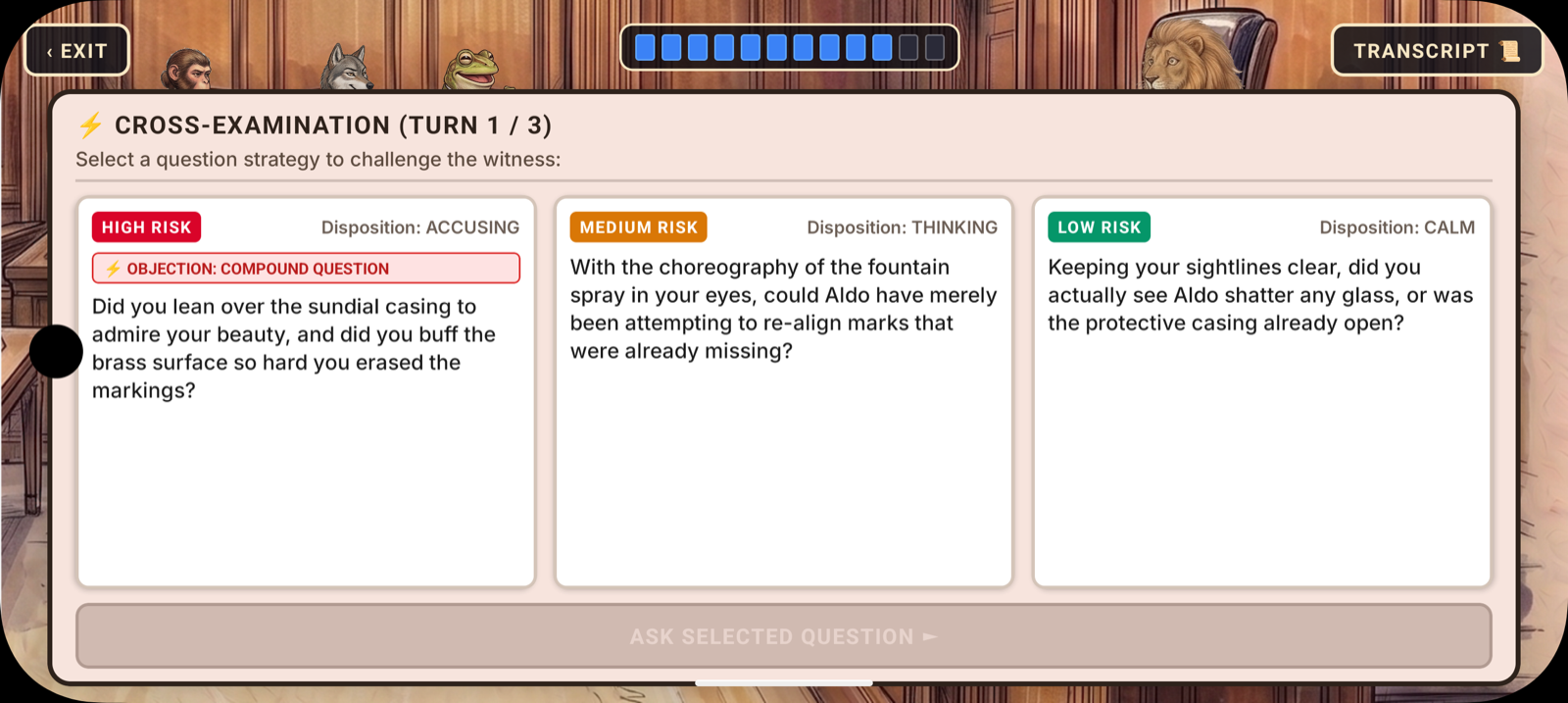
So I'm ripping it out and replacing it with an opportunity system that's going to take a fair bit of work to get right.
The biggest change: when you're questioning your own witness, there are no objections anymore. In a real trial, your direct examination is pre-rehearsed — you know what your witness is going to say because you've gone over it with them. Neither side objects to their own witness; that'd be weird. So instead of worrying about objections during direct, your own witness questions now show you which juror the answer is going to affect. You're not playing defense during direct — you're strategically shaping the jury, one answer at a time.
Of course, removing objections from direct meant I needed to give the player something to do when it's the other side's turn questioning their own witness — when you're sitting there watching the prosecution build their case and can't object. That's where key facts come in. During the prosecution's direct examination, you can "write down" key facts — things you notice in the testimony that might be useful later. But here's the catch: you can only keep three of them. That means you're constantly making judgment calls about what's worth remembering and what's noise. Write down the wrong fact and you've burned a slot you can't get back.
Those key facts pay off during cross-examination, which has been completely restructured. A cross-exam is now three-tiered: first, a regular question to establish your footing — safe, no risk, no reward beyond the basics. Then, if you recorded the right key fact during direct, you can deploy it for a pointed follow-up that the witness can't easily dodge. And finally, if you're feeling lucky, you can push your luck with an objectionable question — one that might land hard but might also draw a sustained objection that loses you credibility with the jury. Regular, key-fact, objectionable. Safe, strategic, risky. That's a real decision tree, not a difficulty slider.
None of this is live yet — it's all design work on paper while the lean system gets bedded in. But it's the kind of rework that happens when you actually play your own game and realize a mechanic that looked good in the design doc doesn't hold up when a human being is sitting there trying to win. The easy/medium/hard system was giving players permission to optimize the fun out of the game, and the opportunity system is my answer to that.
ShutterClash: We're on the App Store!
The news that completely reshaped my week: ShutterClash got approved for iOS. It's live on the App Store.
This has been months in the making — the account deletion endpoint for Apple's compliance requirements, the responsive layout overhaul for compact iPhone screens, the RevenueCat integration, the DB pool work, the card timestamp system that feeds the Pixoo display. All of it was building toward this, and now it's actually here.
I'll be updating the product page link later today. For now: it's real, it's approved, and you can download it. Heck yes.
The Quiet Corner
Doodle Doo, Headline Harmonies, and Infinite Scribe had a quiet week while I focused on SBU's jury mechanics and getting ShutterClash across the finish line. That's the solo dev rhythm: you sprint on what's hot, and the rest waits its turn.
It's a good kind of busy, though. SBU's jury is starting to feel like a real jury, its question system is getting rebuilt from first principles, and ShutterClash is actually on the App Store — the kind of milestone that makes everything else feel worth it.
More next week. Hopefully with fewer design documents and more code.